
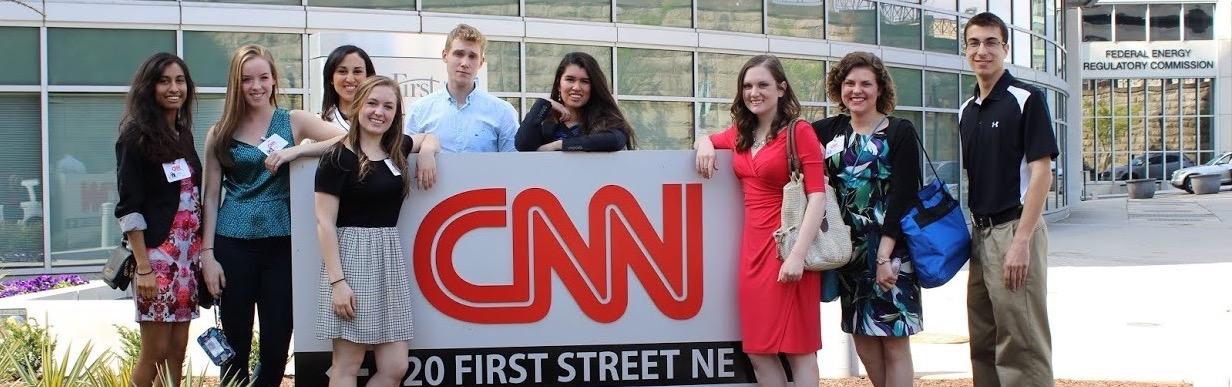
It’s critical that you get real-world, hands-on experiences based on the skills and ethics we teach you in class. That’s why every degree-seeking journalism undergraduate MUST land a journalism internship. You’ll also be asked to take a corresponding internship class in order to graduate.
If you want to do more than just one internship, note that undergraduates may also receive internship credit for an elective class. Master’s students are encouraged to find internships and may take one for credit. Our internship classes are discussed below.
Jump to: How to Land an Internship | What Counts for Credit | Courses | Resume & Cover Letter Tips
How to Land an Internship
While there’s more information elsewhere on these pages, here are your quick tips:
- Check the web for the media you read and use – chances are good that company will have an internship program.
- Ask your friends or professors for recommendations about internships they know about.
- Read the emails from the Merrill College Career Center. Director Karen Denny will send out information about internships as she hears about them.
- On Twitter/X, be sure to follow @MerrillWorx and @merrillcollege.
- Look on the boards on the first- and third-floor hallways, where internship fliers are posted.
- Check the evergreen listings of local media elsewhere on this website for ideas about where to look.
- Now apply with a good cover letter, resume and portfolio (see below).
What Counts For Credit
- It must be JOURNALISM. No public relations, marketing, communications, sales, events or promotions opportunities are going to cut it for our credit. Think independent – if you can’t say something critical about the topic you’re covering without getting shot down, then it’s probably not journalism. (Some exceptions may be made for production-only internships or for the JOUR 199 credit on a case-by-case basis).
- It may be in-person or virtual, although in-person is preferred. We want you in a newsroom to experience the mentorship, camaraderie and regular work environment. However, we recognize that many internships converted to virtual during the pandemic. All internships must be supervised and cannot be self-posting; all previously in-person internships that converted to virtual are automatically approved. Always-virtual internships will be evaluated case by case for quality.
- Internships in the newsrooms of independent, general-interest newspapers, news websites, magazines, television or radio news departments or network news operations count for JOUR 396 credit. So do production internships at most commercial sports news operations (such as NBC Sports Washington or ESPN), and internships at specialty publications, such as the Baltimore Business Journal, The Daily Record in Baltimore, special-interest magazines, trade publications, and the Washington bureaus of news outlets. (Please: No working for teams, team owners, stadiums, leagues, talk shows of any kind, nonprofit advocates, entertainment television/film producers, federal or state government press offices or religious organizations, except independent news producers.)
- We expect you to work in internships that put to use the tools you have earned in journalism classes, such as reporting, story research, writing, copy editing, broadcast news production, assignment desk duties, web production or editing, news videography or photography, audio editing, graphics, page design, social media management or data-driven graphics. You can expect to do some grunt work on your internship, but that should not be the bulk of what you do. And grabbing coffee or lunch for your colleagues or supervisors may be a nice thing to do, but it should not be a part of your internship requirements.
Courses
So now you have an internship. What class do you take and what do you need to do to register?
In all cases, you MUST MEET with Karen Denny, Merrill College's internships and career development director, to receive approval to register for class. She’ll need your unofficial academic transcript and a signed Intern Proposal Form. Contact her at kdenny12@umd.edu, to schedule an appointment to go over this paperwork, to review the syllabus and course requirements and to complete an academic honesty pledge. This must occur before the end of the drop/add/schedule adjustment period.
JOUR199 – Survey Apprenticeship (1 credit)
This is the OPTIONAL, elective class for any undergraduate student who has taken and passed 201. Take this class for unpaid internships for practice where credit is required or where you want your internship to show up on your transcript. There are no regular class meetings; the class is conducted through ELMS.
It requires you to:
- Work at least 60 hours under the supervision of professional journalists for at least eight (8) weeks during the Spring or Fall semesters, at least five (5) weeks during either summer term or at least three (3) weeks during winter term. All hours counted toward this requirement must fall on or after the first class day of the session enrolled until the last class day of that session. (See special summer rules.) You may work MORE than required, but not less, or risk failing the class.
- Contribute to a class blog on ELMS reflecting on your experience.
- Turn in timesheets proving your hours.
- Be evaluated at least once in writing by your supervisor.
JOUR199 may be repeated, with permission of the instructor.
JOUR396 — Supervised Internship (2 credits)
This class is the REQUIRED for graduation for undergraduate journalism majors on the Gen-Ed curriculum (look on the top of your unofficial transcript in Testudo for this information). It requires you to work off campus in a professional journalism internship. This class does not have regular sessions, although you must meet at least twice with your instructor; it largely is conducted through ELMS. This class is not offered in winter term or in the second summer session.
It requires you to:
- Have taken and earned a “C-” or better in JOUR201 to enroll.
- Have a minimum 2.0 GPA.
- Work a minimum of 90 hours over at least 10 weeks during the spring or fall sessions, or a minimum of eight weeks in the summer. (It is offered only during the first summer session, but students have until the end of the second summer session to complete the requirements.) All hours counted toward this requirement must fall on or after the first class day of the session enrolled until the last class day of that session. You may work MORE than required, but not less, or risk failing the class.
- Complete a reflection essay about the company and your experiences.
- Meet once with your instructor and complete your job-seeking documents: resume, cover letter and reference list.
- Attend a career panel or presentation by professionals in the industry.
- Produce a portfolio of work or diary of experiences earned on your internship.
- Turn in timesheets.
- Be evaluated twice by your off-campus internship supervisor.
Steps to take to secure credit
Your employer may require you to provide a letter assuring them you’re a student in good standing here at the college. Here’s how you get one of those:
Internships and Career Development Director Karen Denny is always ready to help – set up an appointment today!
Send an email to Internships and Career Development Director Karen Denny, or call her at 301-775-8483. Office: 3105A Knight Hall.
Include:
- The details of your employment – what you will do and who you will be doing it for. Make sure it’s a journalism job.
- The supervisor’s name and title, the company and address of the person who is to receive the letter, and an email address for the supervisor.
- Your unofficial transcripts, so that the director can verify that you are a student in good standing at Merrill College.
- Please allow time for Ms. Denny to prepare the letter. Last-minute requests will be accommodated as schedules permit. This letter DOES NOT REPLACE completion of the registration steps outlined above.
Restrictions:
- Students may not earn credit for internships retroactively.
- The deadline for enrollment is firm. No requests for late registration will be honored.
- Only JOUR199 is offered during the winter term and summer session II.
Nonsupervised internships
Look for opportunities to get experience during the summer and during winter term.
Many Merrill College students hold down internships during the school year that go beyond their core requirements. Be sure to take advantage of the Journalism Career Fair — held in October at Stamp Student Union.
Recruiters come to Knight Hall many times throughout the school year as well. Making early contacts can lead to internships and even jobs down the line.
Resume & Cover Letter Tips
Need assistance writing your journalism resume or cover letter? These tips will help.
Resumes
Overview
You’ll need to create a resume before you start applying for journalism internships or jobs.
The trick is to produce an easy-to-read, one-page document that provides your contact information, details on your past employment and journalism experience, awards and special skills. Most employers will spend only a few seconds reading it. You want to leave a good impression by being accurate, concise and direct.
We encourage you to also post your resume online using a blogging tool, such as WordPress (although you might not want to list your home address or phone number on this Web version). However, don’t send a print-out of your online version by mail or fax. It won’t look as professional as one created on paper. Create a separate word or rich text version for mailing.
It’s OK to design a resume using a graphics program, but make sure you also have a plain-vanilla version that can be easily emailed to an employer, using Microsoft Word (which offers a number of resume templates), rich text or PDF, for instance. (It won’t matter how pretty your resume looks if the employer cannot open the file.)
Basic Tips
- A journalism resume must be a single page.
- Avoid using “I” or other personal pronouns.
- Break up your resume with small subheads for each major category under your name and contact info. Subheads might include: Education, Journalism Experience, Other Work Experience, Awards and Honors, Memberships, Specialized Skills.
- Do include what degree you are seeking and when you expect to graduate in the Education area; include your GPA if it is a 3.5 or better. Do spell the name of our college and university correctly. (One out of every 20 resumes I see misspells Philip Merrill.)
- List activities and jobs in reverse chronological order within each of these categories.
- Use 12-point type for the body of your resume – don’t reduce the type. If an employer has to squint or strain, she may not bother to read it. Use a bit larger font for your name and subheads, and bold them. Stay away from hard-to-read fonts. Choose only one or two font styles for the whole page and be consistent. All subheads should be in the same font style; all body type should be in the same font style. If your achievements don’t fit onto one page, write more concisely.
- Use white space efficiently. Use bullets and indentations sparingly.
- Objective sentences are unnecessary on resumes when applying for journalism jobs. You will discuss your objectives in your cover letter.
- Use past tense to describe past experiences. Use present tense for the activities that are ongoing at the time you are sending your resume.
- Be specific and be honest! Don’t claim to be a staff writer for a campus publication if you only attended one meeting. Also, don’t say you are “currently” working for a publication or news station if you are taking a semester break.
- Tailor your job objective for a cover letter. Don’t put something generic on your resume.
- Proofread, proofread, proofread. Typos or grammatical errors will cost you jobs.
The Resume Categories
Contact information
Be sure your name is bold and in larger type than the rest. Use the address where you will most likely be receiving mail (rather than having it forwarded to you), the phone with the most reliable message system and the email address you check most often. For instance:
Teresa Terrapin
1111 Turtle Lane, College Park, Md. 20742
Home: 301-555-1122; Cell: 240-111-6666
tterrapin@umd.edx
If you are serious about looking for a job, be sure your voicemail and email address reflect your intentions. (In other words, remove the musical intro on your voice mail and avoid cutesy or suggestive email addresses.) Once you’ve sent your resume, be sure to regularly check your email as well as your phone for messages.
Education
List your university, the degree you are seeking and the anticipated date of graduation. You may also list a great GPA – 3.5 or better. If you have a citation from an academic honors program such as Gemstone or College Park Scholars or have studied abroad for a semester or two, you should list that here, as well. Example:
University of Maryland, Philip Merrill College of Journalism, College Park, Md. Double major in journalism and political science. GPA: 3.8. B.A. anticipated in May 2011.
Journalism Experience
List what you did, where you did it and when. Also include a line that tells the employer the size and type of publication, the website usage or the market of the broadcast station. To make the text stand out, use italics and bolding sparingly. For example:
Statehouse reporter, Capital News Service, Annapolis, Md. – September to December 2010.
Covered the Maryland General Assembly as part of a university-run wire service with more than 74 clients. Focused on clean and alternative energy.
News editor, The Diamondback, College Park, Md. – January to May 2010.
Served as chief news editor for university’s independent daily student news outlet with circulation of 17,000. Oversaw a staff of 10 reporters.
Other Work Experience
Here’s where your list summer jobs, on-campus or part-time positions and other volunteer activities. Don’t hesitate to put that waitress or sales clerk position down – it shows you can juggle work and school and understand the value of a job. Any mentoring and tutoring experiences should go here, too.
Awards, Honors, Memberships
Put down scholarships, writing awards and other honors you’ve been given. Memberships or other affiliations can go here, as well.
Specialized Skills
A good category to include, but only if you’ve got some. Don’t put Microsoft Word. That’s not specialized. But if you are familiar with a particular broadcast editing system such as Avid, or have proficiency with web-editing tools such as Dreamweaver or WordPress, photo-editing tools such as Photoshop, audio-editing tools such as Adobe Audition or Audacity, video-editing tools such as Final Cut, interactive web tools, or have studied computer-assisted reporting with Ira Chinoy, or speak Spanish or another language fluently, put it down! The rule of thumb is – if it makes you stand out from the other candidates, it’s worth including on your resume.
References
Place a list of references on a separate sheet, with all your contact information from your resume at the top. These sheets should MATCH your resume; same font styles and sizes.
Who should be a reference? Previous/current employers, professors, adults who know you well and can speak to your character. Never include other students. Make sure you have asked your references if they mind getting a call from a potential employer — and if the can say good things about you. If using a professor, use those who taught classes in which you earned an A or B.
Include each reference’s name, title, company, work phone number and email address at a minimum. If you can, also include work addresses for each.
Include three to five references on your sheet, unless specifically told otherwise.
Letters of reference
They're nice, but not necessary unless specifically requested by the employer.
Cover Letters
Overview
Always send a cover letter or an email message with a resume. Which is more appropriate? It depends on these factors:
- If you are mailing your application, a formal business letter is most appropriate.
- If you are emailing your application, pay attention to what the employer has requested. If she or he asks for a cover letter, send one. If none is requested, a short, professionally worded email should be fine.
Whichever type of letter you use, consider it an opportunity to demonstrate good writing and professionalism.
Tips for both letters and emails
- Keep your text short, accurate and concise.
- Always address your letter or email to the appropriate editor or producer. Make sure you spell his or her name correctly. With names such as Chris and Randy and Tracy, don’t assume the gender. Always triple-check spelling of names and titles, using different, reliable sources.
- Do not start the text with, “To Whom It May Concern.” Use your journalism training and find out who is doing the hiring.
- Do not address a professional you do not know by his or her first name. Use Mr., Mrs. or Ms.
- Proofread, proofread, proofread.
Email etiquette
- Always fully identify yourself — first and last name, especially if your email address does not identify you fully.
- Use a proper format – a greeting line, a paragraph or two of text and a closing line. IMing or text messaging are not acceptable formats for emails to professionals. Please use complete sentences, good grammar and spelling. This is expected of journalism students, and you will embarrass yourself if there are grammatical errors or typos in your email messages.
- Check your tone. Emails differ from telephone conversations, in which you can detect anger, humor, confusion, etc., at the other end. If you are making a request, do not put it in the form of a demand: “Send me the name of …” Avoid accusatory statements such as, “You did not respond to my email …”
Guidelines for cover letters
General guidelines
- Use a professional business letter format, with your address and the date at the top (either centered or aligned left), followed by the name, title, company and address of the recipient doublespaced below that (aligned left). Most software programs such as Word offer business letter templates.
- Avoid cuteness, colloquialisms, puns and off-color humor at all costs.
- Don’t be wishy-washy. You won’t inspire confidence with phrases such “I think I’m qualified,” or “I believe I’m the right person for the job,” so leave them out.
- Keep the letter to a single page, usually no more than three or four paragraphs. Employers are busy people. They don’t have time to read more than a few graphs. If you are having trouble making everything fit on one page, that’s a tip that your letter is too long.
Introductory paragraph
Your first paragraph should grab the reader, motivate him or her to move on to your resume and clips. You can do that in three ways:
- An anecdote. Using a personal experience can illustrate your talents as a journalist. Your anecdote can be about a great story you broke, the way you pursued a particular source or something more personal that inspired you to enter journalism. The trick is to keep is short – it’s only the introduction.
- A personal reference from someone the reader respects is another good opener. Examples would include a colleague, a former boss or a well-regarded professor. Make sure you have the person’s blessing before including him or her in the letter. Example: John Smith, city editor of the Maryland Banner, recommended I contact you.
- Get right to the point. If you lack an anecdote or a personal connection, simply introduce yourself and say why you would be worth hiring. Be confident.
Middle paragraphs
Highlight your experience, but don’t exaggerate. Don’t repeat your resume — complement it. Talk briefly about stories you’ve written or experiences you’ve had that make you a great candidate for this particular job. Talk about your ambition and what motivates you. Avoid listing courses you’ve taken. JOUR 320 won’t have much meaning to an employer, and listing your college coursework just makes you seem young and inexperienced. Instead, talk about the skills you’ve gained in JOUR 320: you’ve learned to interview public officials, write a profile piece, bang out a story on deadline.
Closing paragraph
Wrap it up. Thank the editor or producer for considering you. Let them know you’ll be in touch in order to schedule an interview. Be sure to sign your letter.
Thank-you letters and emails
Good manners never go out of style. If an employer has taken the time to interview you, be sure to send a follow-up letter or email thanking him or her for the time. A letter is more formal than an email, but also more impressive. You can also use this letter as an opportunity to supply some fresh examples of your work.